
pressure die-casting defects
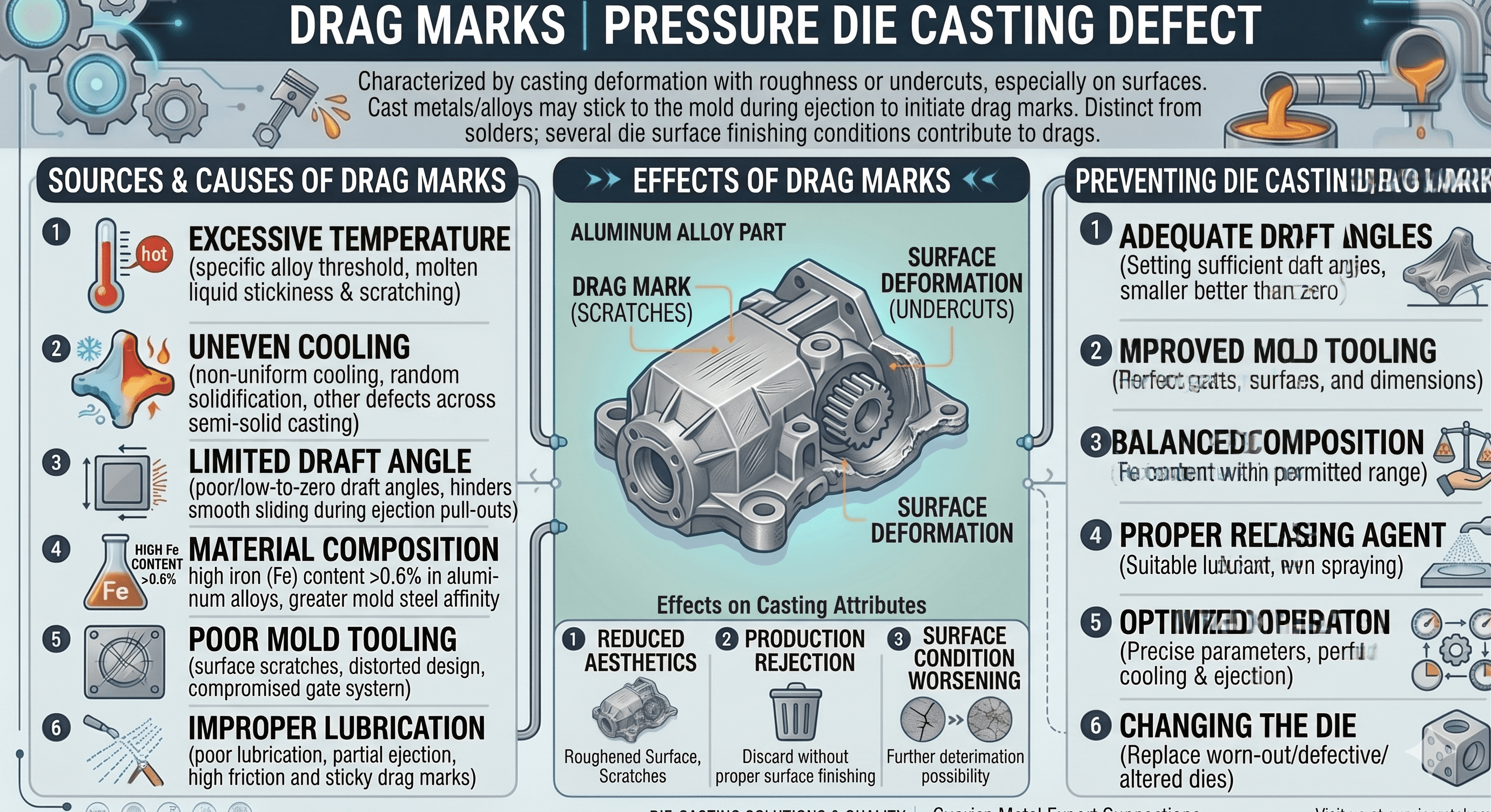
Drag marks or drags are the most common cosmetic defects in die-casting productions. Drag-Marks-on-Aluminum-Die-Casting It characterizes casting deformation with roughness or undercuts, especially on the surfaces. The cast metals/alloys may stick to the mold during ejection to initiate drag marks. Drag marks shouldn’t be confused with solders as the two share considerable similarities in appearance. Unlike solders, several die surface finishing conditions contribute to drags. The article briefly discussed the sources, effects, and countermeasures for die-casting drags.
Sources of Drag Marks Significant mold-metal adhesion or stickiness is the ultimate reason behind this casting defect. And multiple factors are responsible for its favorable environment – Compromised-Aesthetics-of-Die-Cast-Due-to-Drags ● Excessive Temperature –Every alloy/metal has a specific temperature limit for casting. Going beyond the threshold makes the molten liquid sticky to scratch the mold surfaces. ● Uneven Cooling –Non-uniform cooling of different casting parts initiates random solidification. It causes various other defects to pop up across the semi-liquid or semi-solid casting. ● Limited Draft Angle –Draft angles play a crucial role in die-casting ejection from the mold. Poor/low to zero draft angle often hinders smooth sliding during pull-outs from molds. ● Material Composition –A higher percentage of Iron (Fe) develops a greater affinity to the mold steel. Any more than 0.6% Fe in aluminum alloys causes the defect to appear rapidly. ● Poor Mold Tooling –Surface scratches, distorted design, and compromised gate system inherit a rough texture. This inhibits stickiness or adhesion to trigger drags and even stains. ● Improper Lubrication –Poor lubrication directly affects the ejection process. Partial ejection from the mold develops high friction between the parts to cause sticky drag marks. The defect interferes with aesthetics, making the final product less presentable. Die casts with drags may be discarded without proper surface finishing. Though they don’t contribute to any mechanical damages, worsening of the surface condition is also possible.
Comments
Sign in to leave a comment.
No comments yet. Be the first!
